
The Power of Perspective: Why Your View of Workplace Relationships Matters
When you think about your relationships at work, what comes to mind first?
Is it the colleague who always supports you? The one who challenges you? Or maybe it’s that quiet tension you feel with someone that never quite gets addressed?
The truth is, the way you see your workplace relationships has more impact than you might realize. It shapes how you interpret people’s actions, how you respond under pressure, and how effectively you lead.
Leader Effectiveness Training (L.E.T.) teaches that strong workplace relationships don’t happen by luck—they come from intentional, skillful communication. And the first step is understanding the lens through which you’re seeing others.
The Power of Perspective (and G.L.O.P.s)
We don’t experience people as they are—we experience them as we perceive them.
Two leaders can see the same behavior and interpret it completely differently. One sees a question as defiance; the other sees it as engagement.
That’s perspective. And sometimes, our perspective gets clouded by what we call G.L.O.P.s—our General Labeling of People.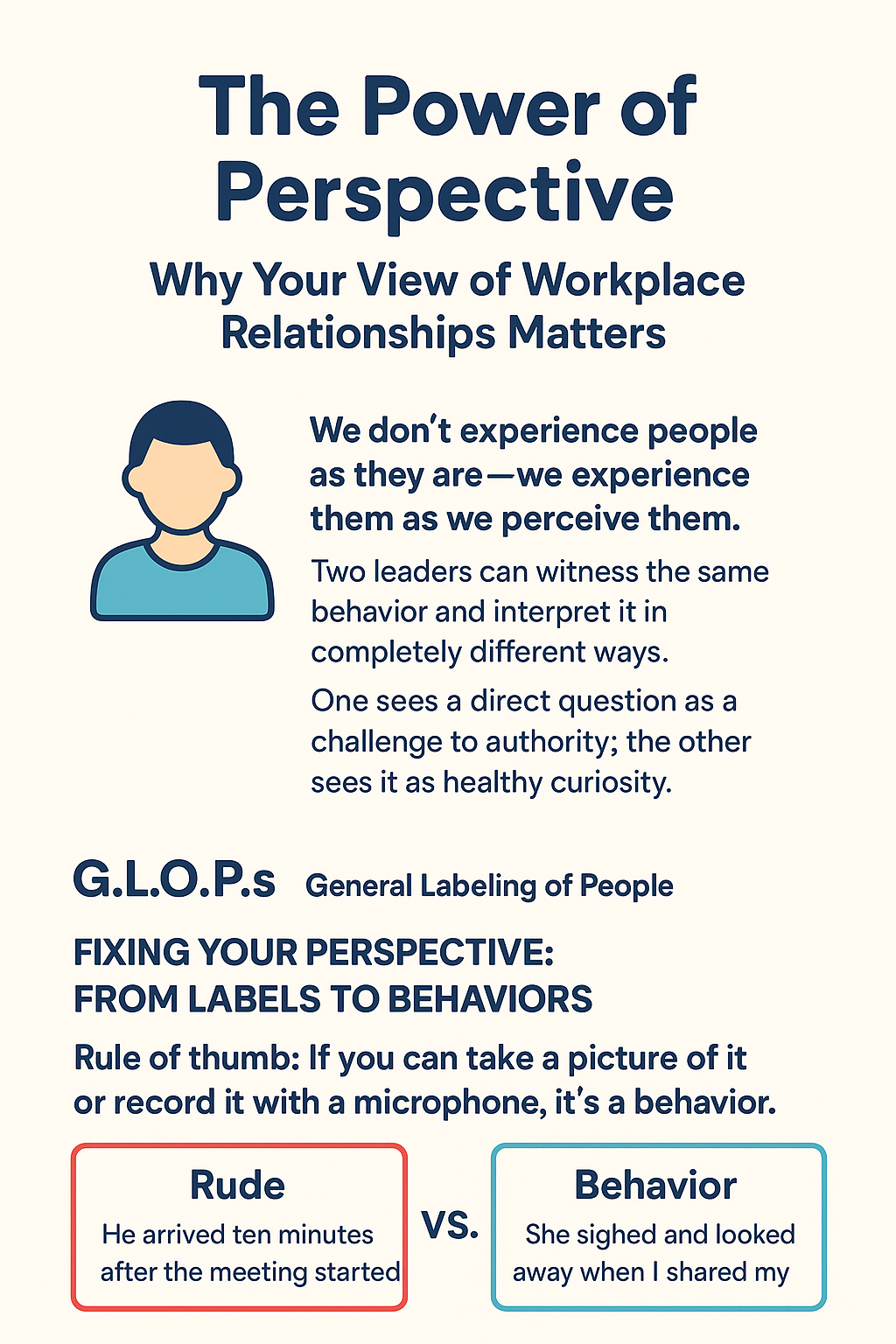
Examples of G.L.O.P.s:
– “He’s lazy.”
– “She’s always negative.”
– “They never listen.”
These sound true in the moment—but they’re not behaviors, they’re judgments. Once we slap on a label, we stop being curious. We see everything that person does through that lens, which can keep us stuck in frustration or distance.
Fixing Your Perspective: From Labels to Behaviors
Here’s a simple L.E.T. rule of thumb:
If you can take a picture of it or record it with a microphone, it’s a behavior.
If not—it might be a label or judgment.
✅ Behavior: “He arrived ten minutes after the meeting started.”
🚫 Judgment: “He’s disrespectful.”
✅ Behavior: “She sighed and looked away when I shared my idea.”
🚫 Judgment: “She doesn’t care what I think.”
When you identify what you can actually see or hear, you start letting go of unhelpful assumptions. This shift opens up space for empathy, accuracy, and better communication.
💡 Bonus tip: If you’re using an adjective, there’s a good chance it’s a judgment.
How Your View Shapes Your Leadership
Your perspective drives your actions.
If you believe a team member is disengaged, you may withhold opportunities from them. If you think your boss doesn’t trust you, you might avoid sharing new ideas. In both cases, the relationship suffers—not because of reality, but because of perception.
That’s why L.E.T. focuses on awareness first—recognizing when you’re reacting to a G.L.O.P. instead of to real behavior. Once you see it, you can shift gears and get curious instead of defensive.
L.E.T. Tools for Better Workplace Relationships
Leader Effectiveness Training gives leaders practical tools to stay grounded in reality and connected to others:
Active Listening: Fully focus on what’s being said, then reflect it back for clarity.
“It sounds like you’re frustrated with the timeline—did I get that right?”
I-Messages: Take ownership of your feelings and needs instead of assigning blame.
“I feel concerned when deadlines are missed because it impacts client trust.”
No-Lose Conflict Resolution: Focus on solutions that meet both sides’ needs so relationships stay strong even when issues arise.
These tools keep communication clear and respectful—so you spend less time guessing what’s going on and more time solving what actually matters.
Quick Self-Check
Take five minutes and reflect on three people you work with often:
- What’s your overall impression of each person?
- What recent behavior stands out?
- Is that behavior a fact you can describe—or a G.L.O.P. you’ve been carrying?
If your answers are full of adjectives or assumptions, that’s your cue to reframe.
Why It Matters
Healthy workplace relationships lead to:
- Higher team performance (trust = collaboration)
- Better retention (people stay where they feel understood)
- Happier clients (cohesive teams get results)
When you change how you see people, you change how you lead. Perspective is powerful. When you start describing what you see and hear instead of what you assume or label, you open the door to real understanding.
Let go of the G.L.O.P., lean into curiosity, and watch how your relationships—and your leadership—transform.

Leave a Reply
You must be logged in to post a comment.